From quadratic and trigonometric
functions to vectors and differentiation…
Deepen Math with Python — Foundations
“Curiosity about mathematics,
the foundation of everything in the AI era.”
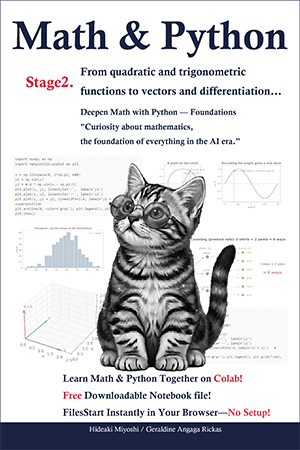
Learn Math & Python Together on Colab!
Free Downloadable Notebook file!
FilesStart Instantly in Your Browser—No Setup!
Download File : MP_Stage2_Colab.zip (English)
Download File : MP_Stage2_Colab_Ja.zip (Japanese)
Table of contents
Chapter 1 Getting Started — Toward Mathematical Exploration
1.1 How to Use This Book — Paper, Pencil, and Python
1.2 Setting Up Google Colab
1.3 Introducing numpy — Handling Numbers “All at Once”
1.4 Introducing matplotlib — Turning Formulas into Pictures
1.5 From Reviewing Middle-School Math to the Gateway of High-School Math
1.6 Quick Reference for numpy and matplotlib
Chapter 2 Quadratic Functions — Exploring the World of Parabolas
Introduction — The Parabola, a Beautiful Curve
2.1 The Essence of a Quadratic — What Is a Parabola?
2.2 Tidying the Expression — Expanding and Factoring
2.3 Completing the Square — the Magic that Finds the Vertex
2.4 Graphs of Quadratics — Vertex, Axis, and Translation
2.5 Quadratic Equations — Where the Graph Meets the x-axis
2.6 Maximum and Minimum — the Vertex Tells the Answer
2.7 Quick Reference for Quadratics (SymPy and Plotting)
Chapter 3 Trigonometric Functions — The World of Waves Born from the Circle
Introduction — The World Is Made of Waves
3.1 Circle and Angle — Radians and General Angles
3.2 Graphs of the Trigonometric Functions
3.3 Transforming the Wave — Amplitude, Period, Phase
3.4 Relationships — Linking sin and cos
3.5 Superposition — Waves Can Be Added
3.6 Application — The Pendulum and its Period
3.7 Quick Reference (NumPy and Plotting)
Chapter 4 Exponentials and Logarithms — Bundling the Worlds of Growth and Multiplication
Introduction — Into the World of Orders of Magnitude
4.1 Exponents — Writing repeated multiplication as one number
4.2 Exponential functions and their graphs
4.3 The number e — a constant of “natural” growth
4.4 Logarithms — a ruler that counts “how many times”
4.5 Exponential and logarithm are inverses — mirror images across y = x
4.6 Log scale — lining up orders of magnitude
4.7 Application — half-life, the logarithmic spiral, and on to entropy
4.8 Quick reference (NumPy and plotting)
Chapter 5 Sequences and Limits — Rules of a Pattern, and the Infinite Beyond
Introduction — One step into infinity
5.1 Sequences — finding the rule in a pattern of numbers
5.2 Recurrence — building the next term from previous terms
5.3 The limit of a sequence — approaching without limit
5.4 Infinite series — what happens when you add forever
5.5 Building functions from series — a preview of Taylor series
5.6 Quick reference (NumPy and plotting)
Chapter 6 Differentiation — Catching the Rate of Change at an Instant
Introduction — from “average” to “instant”
6.1 Average rate of change — the “rate” over an interval
6.2 Instantaneous rate and the derivative at a point — shrinking the interval without limit
6.3 The derivative — turning “slope at each point” into a function
6.4 Tangent lines, velocity and acceleration — the first application of differentiation
6.5 Newton’s method — solving equations with tangents
6.6 Optimization — finding the highest / lowest point
6.7 Differentiation quick reference (NumPy and plotting)
Chapter 7 Integration — Adding Up Small Pieces to Grasp the Whole
Introduction — grasping the whole by “adding up”
7.1 We want to find an area — tiling with rectangles
7.2 The definite integral — making the rectangles infinitely thin
7.3 Differentiation and integration are two sides of a coin — the fundamental theorem
7.4 The indefinite integral and basic formulas — tracing differentiation backwards
7.5 Applications — from velocity to distance, and to work
7.6 Numerical integration — the trapezoidal rule and Monte Carlo
7.7 Integration quick reference (NumPy and plotting)
Chapter 8 Organizing with Classes — Bundling Data and Behavior into One “Object”
Introduction — why learn classes here?
8.1 Class and instance — “blueprint” and “object”
8.2 init and self — initializing an object when it is created
8.3 Methods — giving objects “behavior”
8.4 Making a math function a class — completing MathFunction
8.5 Encapsulation and reuse — the “joy” of bundling
8.6 Inheritance (advanced) — inheriting shared structure
8.7 Class quick reference 197
Chapter 9 Counting and Probability — Counting to Grasp Likelihood
Introduction — capturing chance with numbers
9.1 Counting — counting “how many ways” correctly
9.2 Permutations and combinations — distinguish order, or not
9.3 Basics of probability — favorable cases / all cases
9.4 The Monte Carlo method — finding probability by trying
9.5 Conditional probability — the probability “given some information”
9.6 Bayes’ theorem — updating likelihood with data
9.7 Counting and probability quick reference
Chapter 10 Statistics and Data Analysis — Summarizing and Reading Data
Introduction — turning a pile of numbers into something meaningful
10.1 Center — capturing the “middle” of data
10.2 Variance and standard deviation — expressing “spread” as a number
10.3 Histograms and the normal distribution — seeing the “shape”
10.4 Correlation — the “link” between two quantities
10.5 Regression line — the line that best fits the data
10.6 The idea of hypothesis testing — is that difference a coincidence?
10.7 Statistics quick reference
Chapter 11 Vectors and Matrices — Quantities with Magnitude and Direction, and Transformations of Space
Introduction — doing math with arrows
11.1 What is a vector — a quantity with magnitude and direction
11.2 Vector operations — addition and scalar multiplication
11.3 Dot product — the “closeness of direction” of two vectors
11.4 Three dimensions and NumPy — vectors in space
11.5 Matrices and linear transformations — moving space
11.6 Representing with classes — building a Vector class
11.7 Vectors and matrices quick reference
Chapter 12 Complex Numbers and the Complex Plane — Beyond the Reals, into a Plane of Numbers
Introduction — a world born from an “impossible number”
12.1 Imaginary and complex numbers — a number whose square is −1
12.2 Operations on complex numbers — sum and product
12.3 The complex plane — placing numbers on a plane
12.4 Polar form and Euler’s formula
12.5 Rotation with complex numbers — multiplication becomes rotation
12.6 The ComplexNumber class and fractals
12.7 Complex numbers quick reference
Chapter 13 Curves in the Plane — Shapes Drawn by Parametric and Polar Forms
Introduction — drawing “shapes” with formulas
13.1 Parametric form — expressing x and y with t
13.2 Circle and ellipse — the most basic curves
13.3 Polar coordinates — a point by distance and angle
13.4 Rose curves — formulas that draw petals
13.5 Lissajous curves — patterns from two oscillations
13.6 The cycloid — a curve traced by a rolling circle
13.7 Curves in the plane quick reference
Chapter 14 Introduction to Differential Equations — Predicting the Future from the Rules of Change
Introduction — the math that answers “what happens next?”
14.1 Rate of change and the derivative — how much is changing now
14.2 The Euler method — advancing into the future a little at a time
14.3 Simulating a pendulum — the Pendulum class
14.4 Population models — the PopulationModel class
14.5 Predator-prey models — the rhythm of nature
14.6 Predicting with simulation — the combined power of mathematics
14.7 Differential equations and simulation quick reference
Appendix Google Colab Basics
1 Colab basics 337
2 Useful keyboard shortcuts
3 Working with Google Drive — saving and loading files
Appendix LaTeX (MathJax) Notation Guide
A.1 Introduction — writing math as “text”
A.2 Basic rules — just four to remember
A.3 Numbers and operators — arithmetic and inequalities
A.4 Fractions, roots, powers, subscripts — the most used
A.5 Greek letters — writing θ and π
A.6 Functions — trig, log, exponential
A.7 Sums, integrals, limits — large symbols
A.8 Vectors and matrices — the notation from Chapter 11
A.9 Symbols and sets — other handy symbols
A.10 Formulas from this book — practice with each chapter
A.11 Quick reference (cheat sheet)