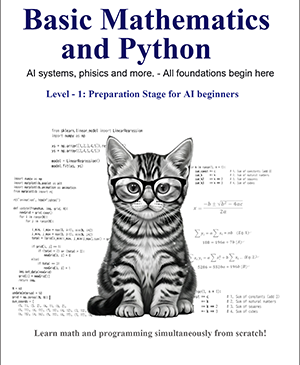
Level – 1 : Preparation Stage for AI Beginners.
AI systems, physics, and more. – all foundations begin here.
Learn math and programming simultaneously from scratch!
“Effectively enhance your learning through practical exercises using
Google Colaboratory notebooks that are integrated with the book.”
Download book-linked files (bmp-101.ipynb) that can be used on Google Colab.
You can download the template notebook file here.
CHAPTER 1. Python Basics
1.1 What is Python?
1.2 Variables
1.2.1 Data Type
1.2.3 Data Type Conversion
1.2.4 Embedding data (numeric values) into a string.
1.3 Operations
1.3.1 Python Arithmetic Operations
1.3.2 Assignment operators
1.3.3 Convenient “Compound Assignment Operators”
1.3.4 Logical operators
1.3.5 Comparison operators
1.4 Containers (Lists, Tuples)
1.4.1 What is a list?
1.4.2 Basic Operations of Python Lists
1.4.3 What is Tuple?
1.4.4 Converting Lists and Tuples
1.5 if…
1.5.1 Basic Structure (if and else)
1.5.2 Multiple Conditions (elif)
1.5.3 Advanced: One-Liner (Ternary Operator)
1.6 for…
1.6.1 Iterating over a list
1.6.2 Looping a specific number of times (range)
1.6.3 Getting the index and value together (enumerate)
1.6.4 Advanced: List Comprehensions (Math Context)
1.6.5 List Comprehensions (Syntax)
1.7 Functions
1.7.1 What is a Python function?
1.7.2 Basic Structure
1.7.3 Create four functions (the four arithmetic operations)
1.7.4 Program using the input() function
1.8 Scope
1.8.1 What is Scope?
1.8.2 Local Variable
1.8.3 Global Variable
1.9 Python libraries
1.9.1 What is Matplotlib?
1.9.2 What is NumPy?
1.9.3 What is SymPy?
1.9.4 What is Scikit-learn?
CHAPTER 2. Basics Mathematics
2.1 Positive and Negative Numbers
2.1.1 Positive and Negative Numbers (Four Arithmetic Operations)
2.1.2 Division is treated as multiplication by the reciprocal.
2.2 Algebraic Expressions
2.2.1 Terms and coefficients
2.3 Equations
2.3.1 What is an equation?
2.3.2 How to Solve Equations
2.4 Functions
2.4.1 What is a function?
Alice’s Short Break!
2.5 Proportionality
2.5.1 Inverse Proportion
2.6 Solve for x
2.6.1 Solve for specific variables such as x or y
2.7 Systems of Equations
2.7.1 Elimination Method:
2.7.2 Substitution method
2.7.3 Form A=B=C into a system of equations
2.8 Linear Functions
2.8.1 What is a linear function?
2.8.2 Linear function slope intercept
2.8.3 Creating graphs with Matplotlib
2.9 Expanding and Factoring Expressions
2.9.1 Expanding expressions, reviewing basic calculation procedures
2.9.2 Expanding Expressions
2.9.3 Prime number
2.9.4 Prime Factorization
2.9.5 Factorization
2.9.6 Methods of Factoring
2.10 Square Roots
2.11 Quadratic Equations
2.11.1 How to Solve Quadratic Equations
2.12 Functions: y = ax²
Alice’s Short Break!
2.13 Vector Basics
2.13.1 Vector Operations
2.14 Matrix Basics
2.14.1 Matrix Operations
2.15 Basics of the Σ symbol
2.15.1 What is Σ?
2.15.2 General Form of Σ (Sigma)
2.15.3 An important property of Σ (linearity)
2.15.4 Main formulas
CHAPTER 3. Basic Math and Python Code
3.1 Use NumPy
3.1.1 NumPy basics
3.1.2 Comparing y=ax with for statement and NumPy
3.1.3 Add a graph
3.1.4 Solving simultaneous equations with NumPy.
3.1.5 Vector operations in NumPy
3.1.6 NumPy matrix operations
3.1.7 Inverting a matrix in NumPy
3.1.8 NumPy Transpose Matrix
3.1.9 Σ (Sigma) operation in NumPy
3.2 Use SymPy
3.2.1 Solving equations with SymPy.
3.2.2 Factorization in SymPy
3.2.3 Solving quadratic equations with SymPy.
3.2.4 Solving vector operations (SymPY)
3.2.5 SymPy Matrix Operations
3.2.6 SymPy matrix scalar multiplication
3.2.7 SymPy matrix multiplication
3.2.8 SymPy matrix inversion
3.2.9 SymPy matrix transposition
3.2.10 Σ (Sigma) operation with SymPy
Alice’s Short Break!
CHAPTER 4. Machine Learning
4.1 Simple Regression Analysis
4.1.1 What is simple regression analysis?
4.1.2 Understanding the basics of simple regression analysis
4.1.3 Drawing and predicting regression lines
4.2 Scikit-learn Machine-Learning
4.2.1 Linear regression model ① Obtaining the slope and intercept
4.2.2 Draw a straight line using the calculation results
4.2.3 Predicting the future
4.3 Evaluate AI predictions
4.3.2 Measure the size of the error: MAE
4.3.3 Calculation and visualization of MAE
Supplementary Explanation : What does Scikit-Learn do?
5.1.1 Least squares method
5.1.2 What is happening inside Python’s model.fit(X, y)
Solutions to linear equation practice problems
Solutions to simultaneous equations practice problems
Solutions to Factorization practice exercises
Solutions to quadratic equation practice problems
Solutions to Vector operations practice exercises
Solutions to Matrix operations practice exercises
Solutions to Σ operations practice exercises
Appendix 1. Basic usage of NumPy
Appendix 2. SymPy basic usage
Appendix 3. Basic usage of Matplotlib