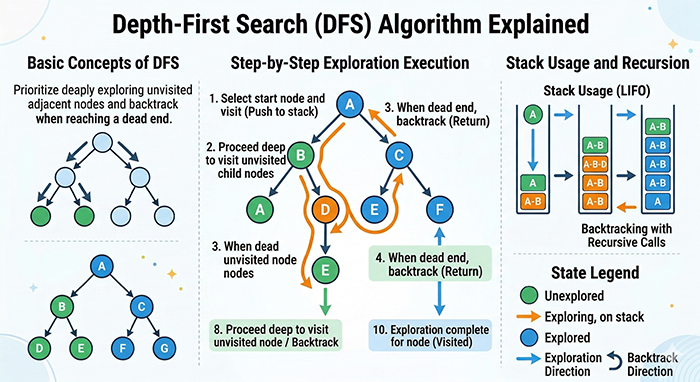
- DFS explores a graph by going as deep as possible before back‑tracking.
- It can be written recursively (uses the call stack) or iteratively (uses an explicit stack).
- The Python snippet above demonstrates a clean recursive DFS on an adjacency‑list representation, plus an iterative alternative.
- Because we keep a
visitedset, the algorithm safely handles graphs that contain cycles.
Simple Python Example
The code below shows a recursive DFS on an undirected graph represented as an adjacency list.
Vertices are numbered starting from 0.
# -------------------------------------------------
# 1. Define the graph as an adjacency list
# -------------------------------------------------
graph = {
    0: [1, 2],          # 0 is connected to 1 and 2
    1: [0, 3, 4],
    2: [0, 5],
    3: [1],
    4: [1],
    5: [2],
    6: []               # an isolated node (optional)
}

# -------------------------------------------------
# 2. Recursive DFS implementation
# -------------------------------------------------
def dfs_recursive(v, visited, graph, order):
    """
    v        : current vertex
    visited  : set of already‑visited vertices
    graph    : adjacency list dictionary
    order    : list that records the visitation order
    """
    visited.add(v)
    order.append(v)               # record the visit
    for nxt in graph[v]:          # explore neighbours
        if nxt not in visited:    # only recurse on unvisited nodes
            dfs_recursive(nxt, visited, graph, order)

# -------------------------------------------------
# 3. Run DFS on every connected component
# -------------------------------------------------
def dfs_all(graph):
    visited = set()
    order   = []                    # overall visitation order
    for v in graph:                 # start from each vertex
        if v not in visited:
            dfs_recursive(v, visited, graph, order)
    return order

# -------------------------------------------------
# 4. Execute and print the result
# -------------------------------------------------
if __name__ == "__main__":
    result = dfs_all(graph)
    print("DFS visitation order :", result)
Expected output
DFS visitation order : [0, 1, 3, 4, 2, 5, 6]
- Starting from vertex
0, the algorithm dives deep into1 → 3 → 4, then backtracks to explore2 → 5, and finally visits the isolated node6.
Iterative (stack‑based) version
If you prefer an explicit stack (e.g., to avoid Python’s recursion limit), here’s a compact iterative version:
def dfs_iterative(start, graph):
    visited = set()
    stack   = [start]          # LIFO stack
    order   = []

    while stack:
        v = stack.pop()
        if v in visited:
            continue
        visited.add(v)
        order.append(v)

        # Adding neighbours in reverse order keeps the same visitation order
        # as the recursive version when we pop from the stack.
        for nxt in reversed(graph[v]):
            if nxt not in visited:
                stack.append(nxt)

    return order

# Example usage
print(dfs_iterative(0, graph))   # → [0, 1, 3, 4, 2, 5, 6]
Both implementations produce the same visitation order; choose the style that best fits your problem size and coding preferences.