- Summary of Step 3 Research Note
Title: CDF Rank-Shape Comparison of Number-Theoretic Spectral Shadows and
Detection of CM Structure
Three Main Findings
Identification of Quadratic Twists: Under the Hasse-normalized convention (w = t²
- 1), CDF rank-shape comparison statistically identifies CM elliptic curves related by
quadratic twists.
Separation of CM and non-CM Curves: Against the Sato-Tate null model, the
framework distinguishes CM from non-CM curves at more than 3σ using JS (Jensen-
Shannon) and TV (Total Variation) distances.
~40-fold Compression of Residual Information: Changing from the raw
convention to the Hasse-normalized convention reduces the entropy deficit,
compressing residual spectral information by approximately forty-fold (36.7x for non-
CM, 37.4x for CM). Crucially, the CDF rank-shape representation still preserves and
detects the CM structure even after this strong compression.
Interpretation and Limitations
Holographic Toy Model: The research uses a “toy model” interpretation where
number-theoretic objects are projected onto finite probability spectra. The experiment
tests which arithmetic structures survive or are lost in this spectral shadow.
Limitations of the Proof: The results are finite experimental facts and do not prove
a direct arithmetic correspondence between elliptic curves and Dirichlet L-spectra.
Additionally, this framework does not implement or prove physical holography or IUT
(Inter-universal Teichmüller) theory.
Future Outlook
Foundation for Step 4: These findings provide a strong foundation for Step 4. The
next goal is to study which information is preserved, distorted, or lost when subjected
to further spectral transformations.
- Summary of Step 4 Report
Title: Majorization and Finite Channel Reachability between Number-Theoretic Spectra
Four Main Findings
Exact Equivalence of Quadratic Twists: Quadratic-twist pairs of CM elliptic curves
with the same CM type are majorization-equivalent, meaning their descending sorted
spectra are identical to numerical precision. Furthermore, the majorization framework
cleanly separates these from cubic twists.
Incomparability of Distinct CM Types: All 24 pairs of CM curves with distinct CM
types (such as Z[i], Z[ω], and D=-7) are structurally incomparable. Their Lorenz
curves cross, preventing any strict majorization order.
Universal Majorization Chain: A strict structural chain emerges across the three
spectrum families: p_raw_elliptic > p_L > p_normalized_elliptic. Every raw elliptic
spectrum majorizes every L-spectrum in the set, and every L-spectrum majorizes
every normalized elliptic spectrum.
Asymmetric Order for CM vs. Non-CM: When the order between CM and non-CM
curves is decidable, it always points in the same direction. In 23% of these pairs, CM
majorizes non-CM (p_CM > p_non-CM), while the reverse inequality is never
observed.
Conclusion and Future Outlook
Integration of Findings: Step 4 successfully recovers all the quantitative, metric-
based claims of Step 3 but translates them into the exact, deterministic language of
partial order and majorization.
Phase 5 Prospect: The natural next phase, Step 5, will investigate whether the
doubly-stochastic channels that realize these structural links possess any explicit
number-theoretic properties, such as entries corresponding to prime or character
labels.
- Summary of Step 5 Report
Title: Constructive HLP Channels and Noise-Breaking Thresholds for Number-Theoretic
Spectra
Four Main Findings
Algorithm Invariance of Mass-Weighted Transport: When testing three different
algorithms to construct the HLP channel, the “mass-weighted mean rank distance”
remained invariant, proving it is a genuine structural feature of the transport. In
contrast, the unweighted mean rank distance fluctuated significantly, exposing it as a
mere construction artifact.
Stratified Noise Robustness: When testing the channels against Dirichlet noise,
the “L → normalized elliptic” segment proved fragile, fully breaking down around a
noise level of ε ≈ 0.5 (with 50% survival at ε = 0.249). Conversely, the “raw elliptic →
L” and “raw → normalized” segments were highly robust, maintaining ≥ 99.5%
survival even at ε = 0.5.
Monotonicity with Lorenz Margin: The ordering of the noise-breaking thresholds
perfectly matched the ordering of the Lorenz margins (0.0052 < 0.0076 < 0.0129).
The segment with the smallest margin broke down under the least amount of noise,
providing a continuous, quantifiable robustness scale.
Quantification of Birkhoff Non-Uniqueness: A two-step composed channel
(D_raw→L then D_L→norm) and a direct one-step channel (D_raw→norm) both
perfectly realized the same target distribution to floating-point precision. However,
the actual matrix values differed significantly (by ≈ 57 in L¹ norm), offering a concrete
quantification of Birkhoff non-uniqueness (i.e., multiple valid matrices can yield the
exact same distribution).
Explicit “Non-Claims” (Important Caveats)
No Arithmetic Correspondence: The report makes no claim of a prime-character
arithmetic correspondence. The apparent label matches are driven by a “rank-
extremity artifact,” where 43% of the transfer mass concentrates at the very top and
bottom ranks simply due to the sorting process and weight construction.
No Canonical Channel or Cycle Structure: Because of Birkhoff non-uniqueness,
the report does not claim there is a single “canonical” doubly stochastic channel, nor
does it assign structural meaning to the greedy Birkhoff-von Neumann
decomposition cycles.
Future Outlook
Directions for Step 6: The report suggests several directions for Step 6, including
mapping the full robustness surface with finer noise grids, testing thresholds at
higher truncation limits, and experimenting with channel constructions tied to
arithmetic labeling rather than strict rank order.
- Summary of Step 6 Report
Title: Phase Map of Lorenz Margin and Noise-Breaking Thresholds Across Truncation
and Noise Geometry
Key Findings and Characteristics
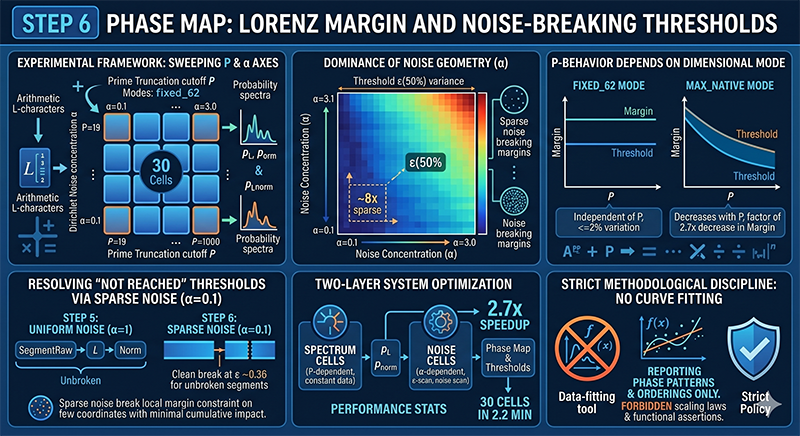
Dominance of Noise Geometry (α): The Dirichlet noise concentration (α) is the
dominant axis determining the robustness of the majorization relations. Across the
30 noise cells, the ε(50%) threshold varies by approximately 8 times between α=0.1
and α=3.0.
Dichotomy of Truncation (P) Based on Dimensional Mode: In fixed_62 mode,
where the target dimension is held constant, the Lorenz margin and the noise-
breaking threshold are essentially independent of P (variation ≤ 2%). In max_native
mode, where the target dimension grows with P, the Lorenz margin decreases
monotonically (by a factor of 2.7x), causing a proportionate drop in the threshold.
Resolution of “Not Reached” Thresholds via Sparse Noise: Under sparse noise
(α=0.1), the previously unbroken segments from Step 5 (raw-elliptic-to-L and raw-to-
normalized) break cleanly at an ε threshold of approximately 0.36. Sparse noise
concentrates perturbation mass on a few coordinates, breaking the local margin
constraint even when the cumulative noise level is low.
Architectural Optimization (Two-Layer System): By separating the α-independent
transport computations (spectrum cells) from the α-dependent noise scans (noise
cells), the framework achieved a 2.7x speedup. This optimization allowed the full 30-
cell sweep to complete in just 2.2 minutes.
Strict Methodological Discipline (No Curve Fitting): The report strictly observes
and reports phase patterns and orderings without asserting any scaling laws or
functional forms. A deliberate “no curve fitting” policy is enforced systematically in
the codebase.
by CHIC INSTITUTE