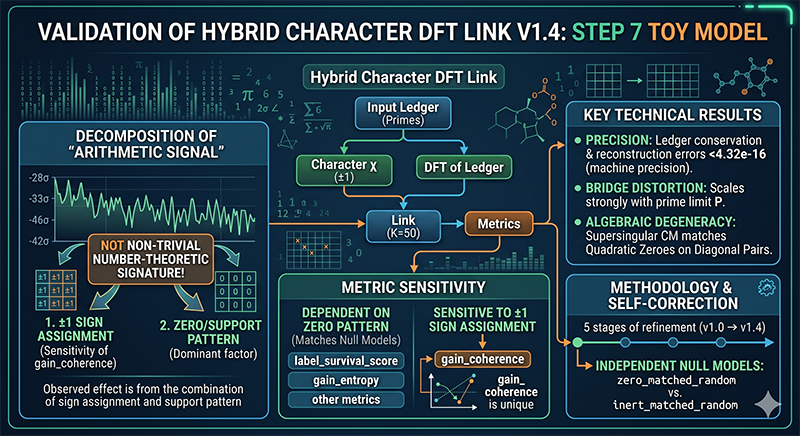
English Summary | Number-Theoretic Holography Toy Model
| Executive Summary This report evaluates a hybrid link combining Dirichlet characters with a discrete Fourier transform (DFT) applied to a prime-ledger signal. The originally observed -28σ to -42σ “arithmetic signal” does not survive as evidence of a non-trivial number-theoretic signature. After improved null models were introduced, the signal was decomposed into two effects: the ±1 sign assignment of the character and the support pattern specifying which prime contributions vanish. The work is therefore best understood as a rigorous structural decomposition of an initially promising signal through repeated self-correction. |
1. Purpose of the Experiment
Step 7 extends the experimental system developed through Step 6 – a prime ledger combined with noise models and bridge transformations – by adding a hybrid character DFT link. For each prime p, the model constructs the complex signal:
z[p] = w(p) · χ(p) · e^(iφ(p))
Here, w(p) is a weight assigned to the prime, χ(p) is a Dirichlet character or randomized control, and φ(p) is a phase term. After routing the signal through a bridge, the experiment applies the DFT, truncates selected frequency components, introduces noise, and measures how well per-prime label information is preserved.
The principal evaluation metrics are:
- label survival score;
- mean label energy retention;
- mean mixing entropy;
- mean phase coherence; and
- gain relative to the trivial character.
2. Self-Correction from v1.0 to v1.4
A defining feature of the study is that a strong initial observation was not accepted at face value. Instead, the null models were improved in successive versions so that the meaning of the signal could be tested more honestly.
| Version | Main Change | What Became Clear |
| v1.0 | Used random_sign_control as the only null model. | Quadratic characters differed strongly from random controls, producing apparent signals of -28σ to -42σ. |
| v1.1 | Introduced FFT-based computation, caching, and Parseval-equivalent reconstruction. | Computational efficiency and numerical precision improved. |
| v1.2 | Added tolerance for boundary decisions in label survival and retained better failure metadata. | Floating-point threshold sensitivity was controlled. |
| v1.3 | Added zero_matched_random_q*, sharing the quadratic character’s zero pattern. | Four major metrics were found to depend only on the zero pattern, not the ±1 sign assignment. |
| v1.4 | Added inert_matched_random_cm_* controls. | The sign-assignment effect and the support-pattern effect could be separated. |
3. Numerical Validity of the Framework
The implementation satisfies the core numerical validation requirements with substantial margin:
| Validation Item | Measured Result | Interpretation |
| Maximum ledger conservation error | 4.32 × 10^-16 | Machine-precision conservation. |
| Reconstruction error at full frequency retention and zero noise | 0.00 | Exact reconstruction under the Parseval-equivalent calculation. |
| Design threshold | < 1 × 10^-10 | Both tests comfortably satisfy the requirement. |
These results show that the later observations are not artifacts of an unstable DFT implementation or a failure of signal conservation.
4. Distortion Introduced by the Bridge
The bridge itself can alter the representation before the DFT is evaluated. Its distortion depends strongly on both bridge mode and prime limit P.
| Bridge Mode | P = 307 | P = 503 | P = 1009 | Ratio (1009/307) |
| mass_bin_fixed | 0.110 | 0.824 | 1.368 | 12.4× |
| native | 0.000 | 0.000 | 0.000 | Always zero |
| zero_pad_fixed | 0.000 | Constraint failure | Constraint failure | – |
For mass_bin_fixed, increasing P from 307 to 1009 increases bridge distortion by roughly 12.4 times. This occurs because multiple primes collide in the same fixed-dimensional bin when P exceeds the target DFT dimension N = 62. The analysis therefore succeeds in separating what is damaged by the bridge from what is affected by the DFT.
5. Reinterpreting the Original “Arithmetic Signal”
In versions v1.0 to v1.2, comparison against random_sign_control produced striking differences:
| Character | gain_survival | gain_entropy |
| quadratic_mod_3 | -28.9σ | -36.2σ |
| quadratic_mod_4 | -28.9σ | -34.6σ |
| quadratic_mod_5 | -38.9σ | -41.8σ |
Initially, these values appeared consistent with a distinctive arithmetic signature. However, v1.3 introduced zero_matched_random_q*, which retains exactly the same zero locations as the quadratic character while randomizing only the ±1 signs. Under this more appropriate null, the following metrics were bit-identical across every tested cell:
- label_survival_score;
- mean_label_energy_retention;
- mean_mixing_entropy;
- gain_survival; and
- gain_entropy.
Consequently, the large apparent signal in these metrics is fully explained by the zero pattern of the character: primes satisfying χ(p) = 0 disappear from the signal because z[p] = 0. The quadratic residue versus non-residue placement of ±1 does not change these metrics.
6. gain_coherence: The Only Metric Sensitive to Sign Assignment
The only metric capable of detecting the ±1 sign assignment is gain_coherence, because phase cancellation changes the magnitude of the combined DFT output. A K = 50 multi-seed analysis produced the following results:
| q | Mean Difference | Combo-Level z-score (K = 50) |
| 3 | -0.0052 | -10.2σ |
| 4 | -0.0020 | -3.4σ |
| 5 | -0.0024 | -5.5σ |
The q = 3 signal remains stable as the seed count increases from K = 1 to K = 50, showing that it is not merely random-seed fluctuation. Nevertheless, later comparisons demonstrate that even this coherence signal is strongly shaped by the support pattern of the weights.
7. Interaction Between the Character and the Weight Structure
The sign of the coherence difference changes according to the type of weight function used:
| Weight Source | q = 3 | q = 4 | q = 5 |
| log_prime | -0.0103 | -0.0076 | -0.0069 |
| uniform | -0.0104 | -0.0078 | -0.0060 |
| shuffled_log_prime | -0.0090 | -0.0065 | -0.0050 |
| elliptic_cm_i | +0.0001 | +0.0036 | +0.0011 |
| elliptic_cm_omega | +0.0015 | +0.0062 | +0.0031 |
Non-elliptic weights consistently produce negative differences, whereas CM elliptic weights produce values near zero or slightly positive. In addition, log_prime and shuffled_log_prime are close in value. This suggests that the signal depends more on the shape of the weight distribution than on a direct number-theoretic correspondence between individual primes and weights.
8. Exact Degeneracy in Two CM Diagonal Configurations
Two natural diagonal pairings exhibit a particularly important exact phenomenon:
| CM Weight | Quadratic Character | Observed Result |
| elliptic_cm_i | q = 4 | Quadratic signal is bit-identical to the trivial signal. |
| elliptic_cm_omega | q = 3 | Quadratic signal is bit-identical to the trivial signal. |
In these cases, the set of primes for which the CM elliptic weight is zero coincides exactly with the set for which the quadratic character is -1. Every prime with non-zero weight therefore receives χ(p) = +1, yielding:
z_quadratic ≡ z_trivial
The report interprets this exact alignment as a geometric reflection of the classical CM split/inert or supersingular pattern within the hybrid DFT model. By contrast, four off-diagonal configurations retain small positive differences that remain unexplained by the present experiment.
9. Two Null Models, Two Distinct Effects
The addition of inert_matched_random_cm_* in v1.4 is central to the final interpretation. It is not a more refined version of zero_matched_random_q*. The two controls address different questions.
| Null Model | What It Measures Relative to the Quadratic Character |
| zero_matched_random_q* | Only the effect of the character’s ±1 sign assignment differs. |
| inert_matched_random_cm_* | Both sign assignment and which prime contributions are zeroed out differ. |
| q | Sign Assignment Only: vs zmr | Mixed Effect Including Support Pattern: vs imr |
| 3 | -10.2σ | Approximately -19σ |
| 4 | -3.4σ | Approximately -17σ |
| 5 | -5.5σ | Approximately -18σ |
The comparison against the CM-support null produces z-scores more than twice as large in several cases. The correct interpretation is not that one null is superior or that a signal vanished; rather, the two comparisons separate the pure sign-assignment effect from the larger support-pattern effect. Accordingly, gain_coherence measures an interaction between arithmetic structure and DFT geometry, not a pure arithmetic signature.
10. Distinctive Behavior of q = 3 Under Frequency Truncation
When the retained fraction of DFT frequencies is varied, q = 3 behaves qualitatively differently from q = 4 and q = 5:
| q | keep = 1.0 | keep = 0.75 | keep = 0.5 | keep = 0.25 |
| 3 | -10.4σ | -40.8σ | -38.0σ | -53.2σ |
| 4 | -6.9σ | -13.0σ | -15.8σ | -14.8σ |
| 5 | -5.2σ | -13.1σ | -21.4σ | -38.4σ |
For q = 3, a significant negative effect is already present without frequency cutting and becomes sharply stronger near keep = 0.75. This pattern is relatively stable across phase mode, bridge mode, and P. By contrast, q = 4 and q = 5 exhibit a more conventional cut-induced strengthening pattern. The experiment cannot determine whether the q = 3 behavior reflects number theory, DFT/bridge geometry, or simply a small-q effect.
11. Final Conclusions
The principal conclusions of the validation report are as follows:
1. The numerical implementation is reliable: ledger conservation and full-frequency reconstruction are verified to machine precision.
2. The initially large signals in label survival, energy retention, mixing entropy, gain_survival, and gain_entropy are completely explained by the character zero pattern.
3. gain_coherence is the only reported metric sensitive to the quadratic character’s ±1 sign assignment.
4. The coherence effect is governed strongly by the interaction between sign assignment and the support pattern of the weights.
5. The natural CM diagonal pairings produce exact algebraic degeneracy, with the quadratic signal collapsing to the trivial signal.
6. Small positive off-diagonal CM effects, negative non-elliptic effects, and the distinctive q = 3 cut response remain structurally observed but unexplained.
7. The experiment does not establish a non-trivial number-theoretic signature; it rigorously decomposes a configuration-dependent structural signal.
| In One Sentence Step 7 is a record of how a striking apparent number-theoretic signal was subjected to better controls and multi-seed verification, ultimately revealing a more careful and defensible result: a structural interaction between character signs, contribution support, and DFT geometry. |
Source Note
This English summary is based on: Step 7 – Hybrid Character DFT Link v1.4 Validation Report: Number-Theoretic Holography Toy Model.