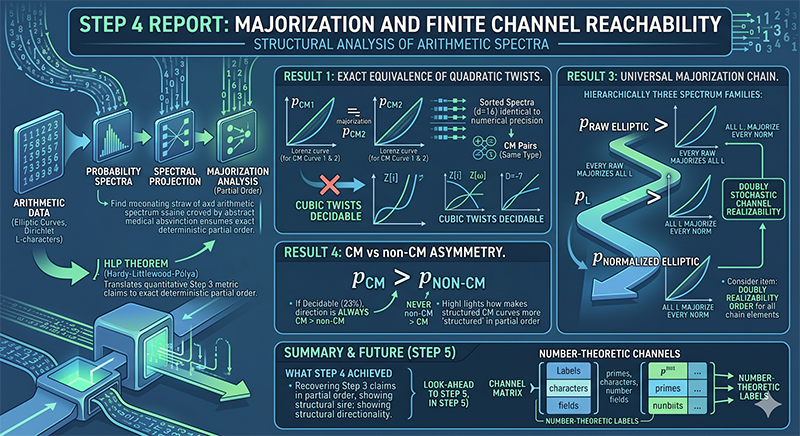
This report details Step 4 of the Number-Theoretic Holography Toy-Model Series. It builds upon the statistical findings of Step 3 by investigating whether probability spectra derived from elliptic curves and Dirichlet L-values are related structurally via finite channels, specifically through doubly stochastic transformations (majorization).
Four Main Findings
Exact Equivalence of Quadratic Twists: Quadratic-twist pairs of CM elliptic curves
with the same CM type are majorization-equivalent, meaning their descending sorted
spectra are identical to numerical precision. Furthermore, the majorization framework
cleanly separates these from cubic twists.
Incomparability of Distinct CM Types: All 24 pairs of CM curves with distinct CM
types (such as Z[i], Z[ω], and D=-7) are structurally incomparable. Their Lorenz
curves cross, preventing any strict majorization order.
Universal Majorization Chain: A strict structural chain emerges across the three
spectrum families: p_raw_elliptic > p_L > p_normalized_elliptic. Every raw elliptic
spectrum majorizes every L-spectrum in the set, and every L-spectrum majorizes
every normalized elliptic spectrum.
Asymmetric Order for CM vs. Non-CM: When the order between CM and non-CM
curves is decidable, it always points in the same direction. In 23% of these pairs, CM
majorizes non-CM (p_CM > p_non-CM), while the reverse inequality is never
observed.
Conclusion and Future Outlook
Integration of Findings: Step 4 successfully recovers all the quantitative, metric-
based claims of Step 3 but translates them into the exact, deterministic language of
partial order and majorization.
Phase 5 Prospect: The natural next phase, Step 5, will investigate whether the
doubly-stochastic channels that realize these structural links possess any explicit
number-theoretic properties, such as entries corresponding to prime or character
labels.
by CHIC INSTITUTE