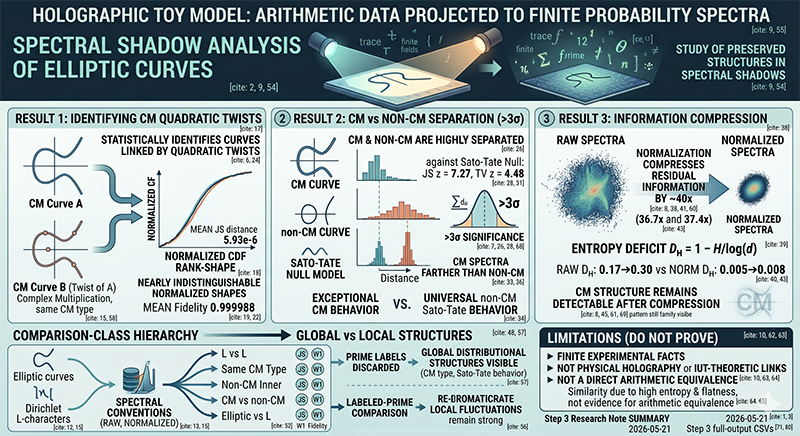
Three Main Findings
- Identification of Quadratic Twists: Under the Hasse-normalized convention (w = t² + 1), CDF rank-shape comparison statistically identifies CM elliptic curves related by quadratic twists.
- Separation of CM and non-CM Curves: Against the Sato-Tate null model, the framework distinguishes CM from non-CM curves at more than 3σ using JS and TV distances.
- ~40-fold Compression of Residual Information: Changing from the raw convention to the Hasse-normalized convention reduces the entropy deficit, compressing residual spectral information by approximately forty-fold. Crucially, the CDF rank-shape representation still preserves and detects the CM structure even after this strong compression.
Interpretation and Limitations
- Holographic Toy Model: The research uses a “toy model” interpretation where number-theoretic objects are projected onto finite probability spectra. The experiment tests which arithmetic structures survive or are lost in this spectral shadow.
- Limitations of the Proof: The results are finite experimental facts and do not prove a direct arithmetic correspondence between elliptic curves and Dirichlet L-spectra. Additionally, this does not implement or prove physical holography or IUT.
Future Outlook
- Foundation for Step 4: These findings provide a strong foundation for Step 4. The next goal is to study which information is preserved, distorted, or lost when subjected to further spectral transformations.
by CHIC INSTITUTE