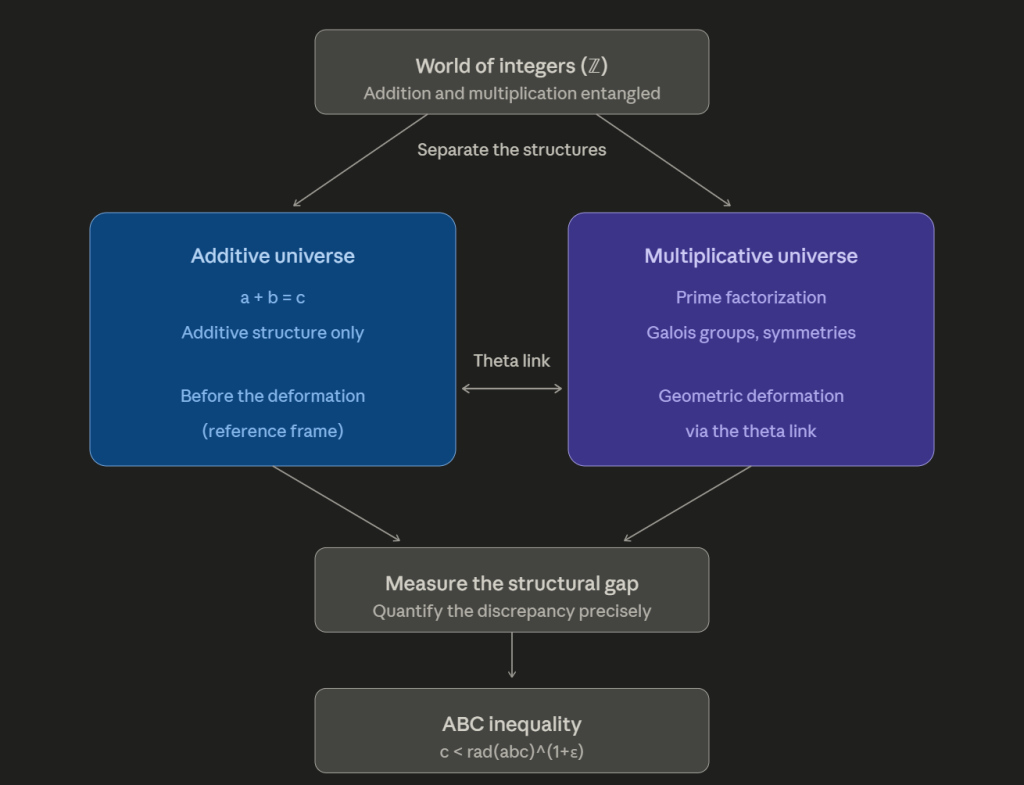
Inter-universal Teichmüller Theory (IUT) is a mathematical theory developed by Professor Shinichi Mochizuki of Kyoto University, made public around 2012.
The Goal The main objective is to prove the ABC conjecture, a long-standing open problem in number theory. Roughly speaking, the ABC conjecture says that there’s a deep constraint between two seemingly unrelated operations: addition (a + b = c) and multiplication (prime factorization).
What “Inter-universal” Means In ordinary mathematics, addition and multiplication coexist in the same “universe of numbers,” and we use them together freely. Mochizuki’s bold idea was to separate the universe where addition lives from the universe where multiplication lives, treating each as an independent mathematical world. He then connects these distinct universes through a special “translation device” (correspondences built from symmetries and deformations), and by comparing the two sides, derives the inequality behind the ABC conjecture.
The term inter-universal refers precisely to this idea of “bridging across different universes.”
An Analogy Imagine treating English and Japanese as fully independent linguistic systems, then using a dictionary (the translation device) to compare two sentences that “mean the same thing but are expressed differently.” The gap between the two expressions itself becomes a source of new information. Ordinary mathematics works within a single language; IUT analyzes the gap between translations across different languages.
Current Status The papers were formally published in a Japanese mathematical journal in 2020, but they are extraordinarily difficult, and only a small group of mathematicians worldwide claims to understand them. Notably, Peter Scholze (Germany) and Jakob Stix have raised objections to a key step. Mochizuki has rebutted these objections, but international consensus has not yet been fully reached.
Why Separate Addition and Multiplication?
This is the heart of IUT theory.
The Source of the Difficulty ABC is hard to attack directly because addition and multiplication are tightly entangled on the same stage—the integers. When you try to handle both at once, they interfere with each other and obscure any handhold.
Think of two instruments playing the same note simultaneously: you want to isolate each timbre, but the sounds blur together.
Limits of Conventional Approaches In standard mathematics, integer addition and multiplication coexist inside the same ring, linked by the distributive law a × (b + c) = a × b + a × c. Because of this entanglement, any attempt to transform or analyze one operation drags the other along with it.
Mochizuki’s Idea Mochizuki took a radical step:
Place the “additive structure” and the “multiplicative structure” on separate mathematical stages—different “universes.”
Concretely, he translates the world of integers into objects that carry only multiplicative information (monoids, Galois groups, symmetries around theta functions, etc.). In this multiplicative universe, the additive structure is deliberately forgotten.
Within this multiplication-only world, he applies a certain geometric deformation called the theta link. This deformation is natural on the multiplicative side, but it does not preserve additive structure.
Measuring the “Gap” Finally, the deformed world is translated back to the integer universe. A discrepancy emerges between the original additive structure and the additive structure reconstructed after deformation. Precisely quantifying this discrepancy is what directly produces the ABC inequality.
Why Different “Universes” Are Necessary Because the relationship between addition and multiplication is altered by the deformation, comparing “before” and “after” inside the same universe leads to contradictions. Treating them as separate universes and bridging them with a translation device is essential. This is why the theory is called inter-universal.