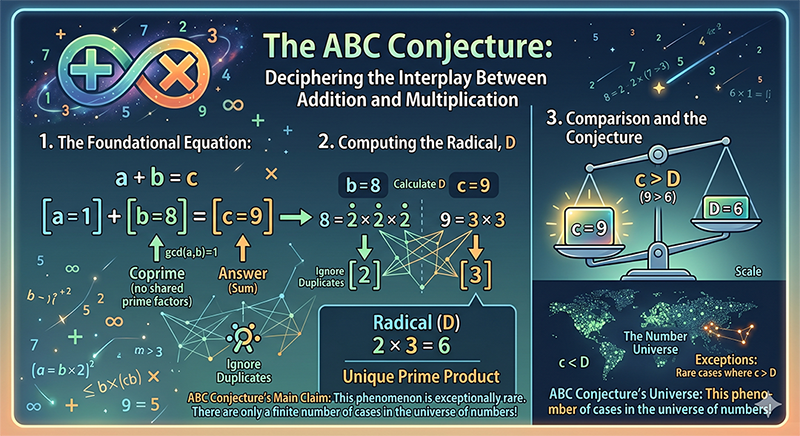
In short, the ABC Conjecture states that “in a simple addition equation ($a + b = c$), it is extremely rare for the numbers involved to be made by multiplying the same small prime numbers over and over again.”
Proposed in 1985, it has long been considered one of the ultimate master-puzzles in modern mathematics, exploring the profound relationship between addition and multiplication.
Here is a breakdown of how it works in the simplest terms.
1. The Basic Equation
First, we look at a very simple addition formula:
a+b=c
There are only two rules:
- a,b, and c must be positive integers (natural numbers).
- a and b must be “coprime” (meaning they share no common factors other than 1, like 8 and 9).
2. Extracting the “Multiplicative DNA” (Calculating D)
Next, we look at all three numbers (a,b,c) and identify what prime numbers were used to build them. Then, we multiply those prime numbers together exactly once, completely ignoring any exponents (repeats).
This resulting value is called D (technically known as the radical).
Let’s look at a concrete example:
Consider the equation:
1+8=9
- a=1 (no prime factors)
- b=8 (broken down, this is 2×2×2. The only prime involved is 2)
- c=9 (broken down, this is 3×3. The only prime involved is 3)
Multiplying the unique primes together exactly once gives us: D=2×3=6
3. What is the “Conjecture”?
Now, look at the example above. Let’s compare the answer to the addition, c=9, with our compressed prime value, D=6.
c>D(9>6)
Interestingly, the final answer c is larger than D.
This happens because 8 (23) and 9 (32) are “powerful numbers”—numbers made by multiplying small primes multiple times. Because our rule for D shrinks those repeats down to just a single count (2×3), the value of D plummets.
Mathematicians noticed that this phenomenon is incredibly unusual. The ABC Conjecture claims the following:
“In the equation a+b=c, cases where the answer c becomes larger than the unique prime product D (c>D) are extremely rare. In fact, if we tweak D just a tiny bit to D1+ε, such exceptions are strictly limited (finite) in the universe of numbers.”
Why is this so revolutionary?
In mathematics, addition (a+b) and multiplication (prime factorization) usually behave like two completely different worlds. When a problem forces them to intertwine, it becomes notoriously difficult to solve.
The ABC Conjecture draws a sharp, definitive boundary around how addition and multiplication interact. Because it strikes at the very core of number theory, proving it to be true would trigger a domino effect—instantly solving dozens of other famous, deeply complex mathematical puzzles in just a single line.