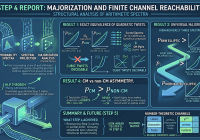
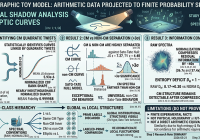
What is IUT Theory?
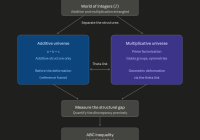
Inter-universal Teichmüller Theory (IUT) is a mathematical theory developed by Professor Shinichi Mochizuki of Kyoto University, made public around 2012. The Goal The main objective is to prove the ABC conjecture, a long-standing open problem in number theory. Roughly speaking, the ABC conjecture says that there’s a deep constraint between two seemingly unrelated operations: addition (a + b = c) and multiplication (prime factorization). What… Read More »
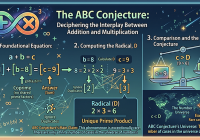
ABC Conjecture – outline
In short, the ABC Conjecture states that “in a simple addition equation ($a + b = c$), it is extremely rare for the numbers involved to be made by multiplying the same small prime numbers over and over again.” Proposed in 1985, it has long been considered one of the ultimate master-puzzles in modern mathematics, exploring the profound relationship between addition… Read More »
IUT Theory: A Fatal Difference of View Regarding “Corollary 3.12”
The clash over “Corollary 3.12” is not a simple disagreement over a calculation error. Instead, it is a profound conflict between two fundamentally different mathematical visions regarding what the true identity of a “number” actually is. Here is a deeper look into the core of this dispute. 1. The Critics’ Stance (Prof. Scholze et al.): “A Logical Collapse”… Read More »
Euclidean Algorithm
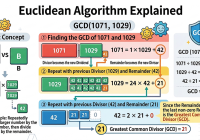
simple algorithm The Euclidean algorithm is a classical method for computing the greatest common divisor (GCD) of two non‑negative integers.The key idea is based on the following property: For any integers a and b (with a ≥ b), the GCD of a and b is the same as the GCD of b and a mod b. Because the remainder becomes strictly smaller each step, the process terminates after only a few iterations, even… Read More »
Depth‑First Search (DFS) Classic AI Algorithms
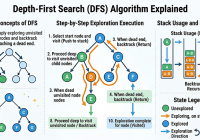
Simple Python Example The code below shows a recursive DFS on an undirected graph represented as an adjacency list.Vertices are numbered starting from 0. Expected output Iterative (stack‑based) version If you prefer an explicit stack (e.g., to avoid Python’s recursion limit), here’s a compact iterative version: Both implementations produce the same visitation order; choose the style that best… Read More »
Fourier Analysis-Algorithms that enrich our daily lives
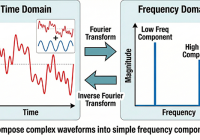
Fourier analysis is a mathematical technique that represents complex signals as the sum of simple waves (sine and cosine waves) with different frequencies. Why is it important? Basic Concept Let’s take a complex waveform as an example and compare it to the timbre of a piano sound. A piano’s timbre is created by multiple strings vibrating at different… Read More »
Trigonometric Functions
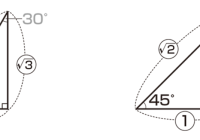
Lengths and ratios of right-angled triangles (Basic knowledge) Trigonometric functions (sin, cos, tan, etc.) are frequently used in machine learning as tools to effectively work with angles, periods, rotations, and positions. Once the angles of a right triangle are determined, the ratio is also determined. Commercially available set squares have well-known trigonometric ratios. As shown in the figure, the… Read More »
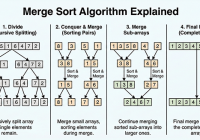
Merge Sort (basic algorithm)
Merge sort is an efficient sorting algorithm based on the divide-and-conquer paradigm. It recursively divides a large array into smaller sub-arrays, sorts those sub-arrays, and then merges them back together to create the final sorted array. Features: Algorithm Steps Example Let’s look at the process of sorting the array [8, 3, 1, 7, 0, 10, 2] using merge sort. Python… Read More »
Calculating Fibonacci Sequence with Recursion (Basic algorithm)
What is the Fibonacci Sequence? The Fibonacci sequence is a series of numbers where each number is the sum of the two preceding ones. It’s defined as follows: The sequence looks like this: 0, 1, 1, 2, 3, 5, 8, 13, 21, 34,… Implementing with Recursion Recursion is a technique where a function calls itself to solve a… Read More »